
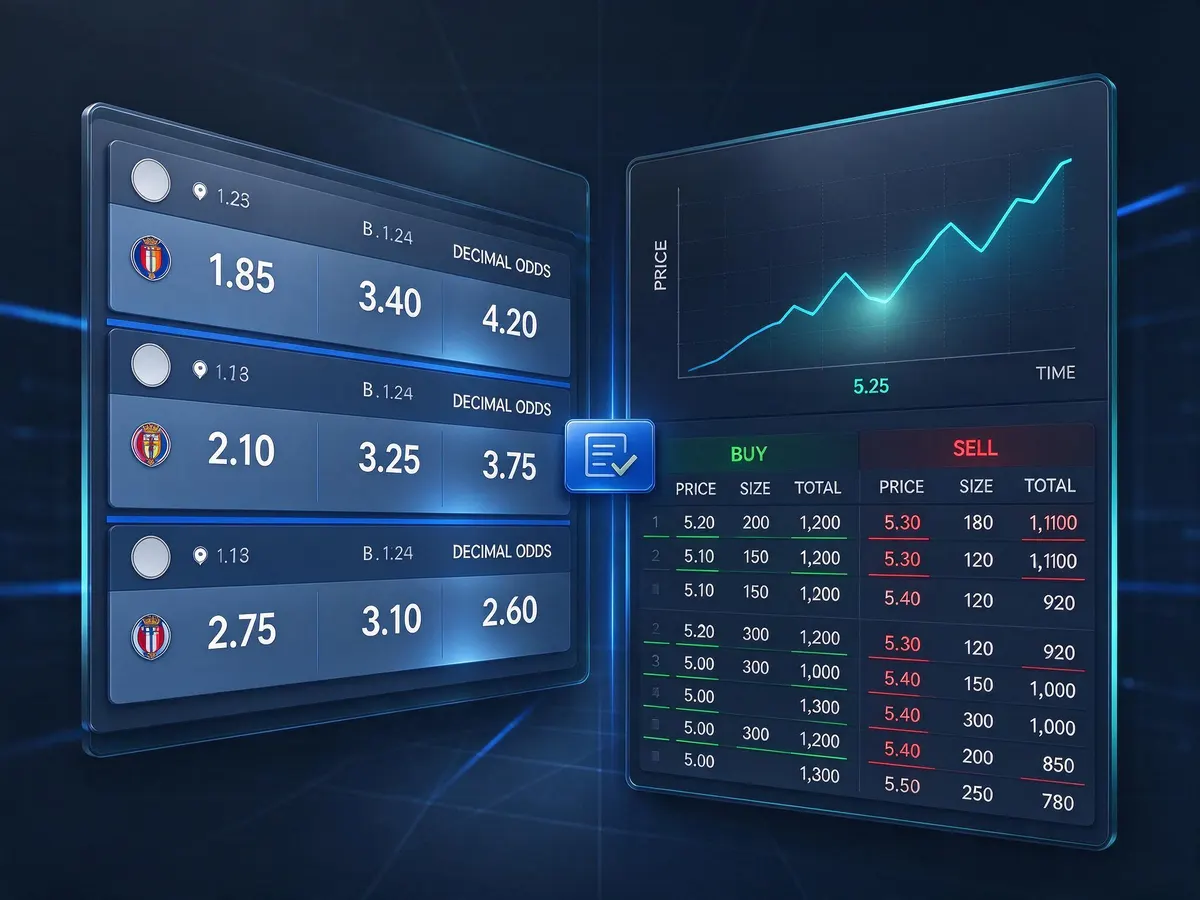
First myth to kill: a prediction market is not a sportsbook wearing a suit. The pricing looks similar, the outcomes look similar, and both can empty your wallet. But the machinery underneath is genuinely different, and if you treat one like the other you will misread what the numbers are telling you. Here are prediction markets explained in plain terms, with the mechanics laid out step by step and a straight comparison against the fixed-odds betting most Indian punters already know.
Prediction markets hit $9.4 billion in trading volume over one weekend
Prediction markets recorded more than $9.4 billion in notional trading volume across a single weekend, according to estimates from Aldrin Research. Kalshi alone accounted for $7.13 billion of that over Saturday and Sunday, per data from TickerTracker, with Sunday’s $3.68 billion breaking the daily record of $3.45 billion set the day before.
What drove the surge was sport, and specifically combo-style contracts that let traders stack multiple outcomes in one position, the prediction market answer to the parlay. That is the real story here: venues originally built around elections and economic data now move most of their size on sports, which puts them in direct competition with sportsbooks. The same week brought a regulatory flavour too, with Polymarket pursuing litigation against the Dutch gambling regulator and Kalshi pushing further into financial products.
One caveat an analyst has to add: notional volume is not sportsbook handle. Volume counts every trade, including contracts bought and resold several times before an event finishes, so a $9.4 billion figure is not the same thing as $9.4 billion of staked money. It still tells you the liquidity is real and growing fast.
What are prediction markets?
A prediction market is an exchange where people buy and sell contracts tied to whether a specific event happens, and the price of the contract reflects the market’s estimate of the probability of that event.
Take a simple example. A market asks: “Will India win this match?” Shares in “Yes” trade at 62 cents. That price implies roughly a 62% chance. If you buy and India wins, each share settles at $1.00. If India loses, it settles at $0.00. You risked 62 cents to make 38 cents, which in sportsbook language is a price of about 1.61 in decimal odds.
How event contracts work
Event contracts are binary outcomes: the question either resolves Yes or No, and the contract pays the full $1 or nothing. Every market has a written resolution rule that defines exactly what counts as a Yes, which data source settles it, and what happens if an event is postponed or voided. Read that rule before you trade. Ambiguity in the resolution criteria is the single most common reason traders feel robbed on these platforms, and it has nothing to do with the odds.
Because Yes and No are two sides of the same contract, their prices add up to roughly $1. If Yes trades at 62 cents, No sits near 38 cents. Buying No is the same economic position as selling Yes.
Who sets the prices
Nobody sets them, which is the part that trips up bettors coming from a sportsbook. There is no odds compiler deciding that India should be 1.61. Prices come from an order book of bids and offers posted by other participants, plus market makers who quote both sides continuously to keep the book liquid and earn the spread. The exchange itself is the venue, not your counterparty. It typically makes money from trading fees rather than from your losses.
How prediction markets work, step by step
The process is closer to placing a limit order on a stock than to clicking an odds button.
- Find the market and read the resolution rules. Check the settlement source, the cut-off time and the void conditions.
- Check the order book depth. Look at how many contracts are available at the best price and how wide the gap is between the best bid and the best offer. Thin books mean you pay more to get filled.
- Place your order. A market order fills immediately at whatever is on offer. A limit order sets your price and waits, which is how you avoid paying the spread.
- Monitor the position. The price moves as news arrives and as other traders adjust. Your paper profit or loss moves with it.
- Exit early or hold to settlement. You can sell your contracts back into the book at any time while the market is open, or let the event resolve.
Buying and selling shares
Suppose you buy 100 Yes shares at 62 cents, a $62 outlay. Twenty minutes into the match the price moves to 74 cents. You can sell all 100 shares for $74 and bank $12 without waiting for the final result, or sell half and run the rest. If the price drops to 40 cents, you can cut the position for $40 and take a $22 loss rather than ride it to zero. That two-way optionality is the feature most sportsbook bettors notice first.
Price discovery process
Price discovery is simply the market arguing with itself in public. Someone with a strong view on a toss, an injury or an election poll posts a better bid, the price ticks up, others react. Over time and across many participants, the price tends to track the crowd’s best collective estimate of probability, which is why researchers like these markets as forecasting tools. It is not magic. Thin markets can be pushed around, and the same source material that flagged this volume record also noted new research examining political bias in election markets, so treat any single price as an opinion with money behind it rather than a fact.
Settlement and payouts
When the event concludes, the exchange settles the market against the stated source. Winning contracts pay $1 each, losing contracts pay nothing, and funds land in your account balance. Fees vary by platform and are usually charged per trade or on profit, so factor them in before you treat a 2 cent edge as an edge at all.
Prediction markets vs sports betting: the differences that matter
Here is the practical comparison. The format gap is cosmetic; the pricing and counterparty gaps are not.
| Feature | Prediction market | Traditional sportsbook |
|---|---|---|
| Price format | Cents per contract (62c ≈ 62% probability) | Decimal or fractional odds (1.61) |
| Who sets the price | Traders and market makers via an order book | The bookmaker’s odds compilers and models |
| Counterparty | Another trader; the exchange matches you | The operator takes the other side |
| Built-in cost | Bid-ask spread plus trading fees | Overround baked into the odds |
| Liquidity source | Open order book, visible depth | The operator’s risk appetite and limits |
| Cashing out early | Sell into the book at the live price | Only if the operator offers cash out, at its price |
| Range of bets | Binary event contracts, some combos | Handicaps, totals, props, accumulators, live markets |
| Winning accounts | Generally welcome, they add liquidity | Often limited or restricted |
Odds and pricing
Fixed odds carry a margin. A two-way market priced 1.90 and 1.90 implies 52.6% on each side, 105.3% in total, so the operator holds a 5.3% overround regardless of who wins. In a prediction market, Yes at 62c and No at 38c sum to 100c, meaning no structural overround. Your costs are the spread and the fees instead. On liquid markets that can work out cheaper; on thin ones, a 4 cent spread is worse than a sharp sportsbook line. If you are rusty on converting between the two, our guide to reading betting odds covers the arithmetic.
Market dynamics
A sportsbook moves its line to manage its own exposure. An exchange price moves because someone traded. That means prediction market prices can gap hard on news and then overshoot, and it means you can be right about an outcome and still lose money if you have to exit into a bad book.
Bet types available
Sportsbooks still win on breadth. Asian handicaps, player props, ball-by-ball in-play markets and multi-leg accumulators are deeper and faster than anything on an exchange. Prediction markets counter with things no sportsbook will price: election results, interest rate decisions, box office numbers, weather. If you want variety inside a single match, the sportsbook market types are still the richer menu.
Are prediction markets legal in India?
Short answer: not in any accessible, regulated form. Event contracts are treated as derivatives in the United States, where Kalshi operates under federal commodities oversight, while Polymarket’s crypto-settled model has drawn regulatory challenges in several countries, including the Dutch case currently in litigation. Neither framework has an Indian equivalent. Indian exchanges regulated by SEBI deal in securities and commodity derivatives, not binary event contracts on sports or elections.
On the gambling side, India’s central legislation on online money games restricts offering, advertising and facilitating payments for real-money online gaming, layered on top of state-level gambling laws that already vary widely. Most international prediction market platforms geo-block or exclude Indian residents in their own terms. Deposits via UPI or cards into offshore platforms also raise payment and foreign exchange questions that most users are not equipped to answer. Our overview of online gambling laws in India goes into the state-by-state picture; treat this section as general information, not legal or tax advice, and get professional guidance before acting.
Which option suits which bettor
If you bet for entertainment on cricket or football, want in-play props and a familiar interface, a licensed sportsbook does that job better. You accept the overround as the price of convenience and breadth.
Prediction markets appeal to a narrower type: people who think in probabilities, want to see the full order book before committing, care about exiting a position mid-event, and have views on things outside sport. They are worse for casual punters. The interface is colder, the resolution rules demand actual reading, and liquidity on obscure markets can be miserable.
Honest accounting on both: sportsbook margins are predictable and usually a few percent per market, while exchange costs are variable and easy to underestimate once fees and spreads stack up. Neither structure gives you an edge by existing. A market price of 62 cents is other people’s opinion, not a forecast you can bank, and the volume records above reflect activity, not profit.
Whichever side you look at, bet only what you can comfortably lose, set deposit and session limits before you start rather than after a bad run, and use the self-exclusion and cool-off tools any legitimate platform provides. If the stakes have stopped feeling optional, stop and seek support.