
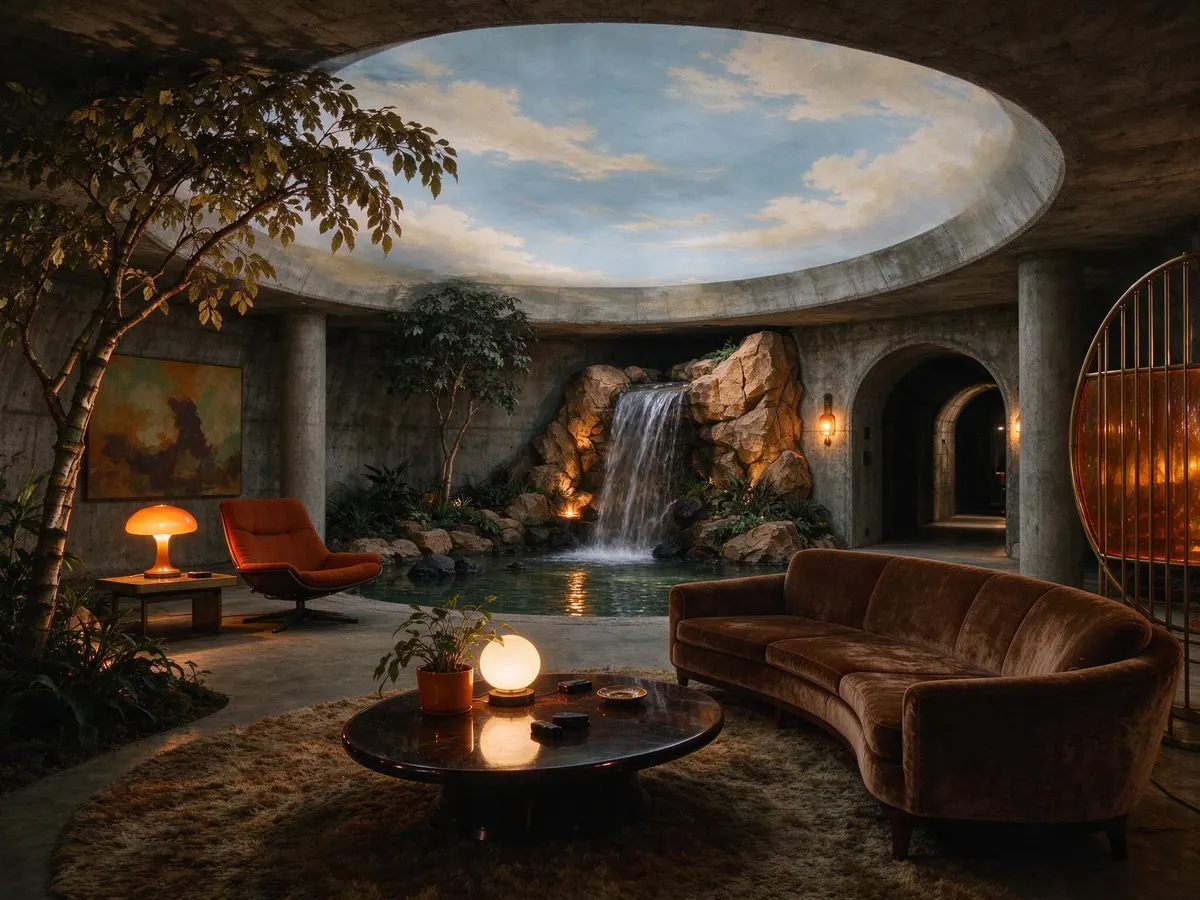
Turn off Flamingo Road into one of the older Las Vegas subdivisions east of the Strip and you’ll drive past a low, unremarkable house on Spencer Street. Single storey. Plain roofline. A backyard that is oddly, conspicuously empty, with a few stacked-stone features that look like garden decoration and are actually air vents. Nothing about it says anything. Nearly three storeys below the lawn sits a 16,000-square-foot Cold War fallout shelter with a painted sky on the ceiling.
That house just changed hands, and the list of Las Vegas off Strip attractions is about to get a new entry. Zak Bagans, host of Ghost Adventures, paid $4.55 million for the property known as the Underground House and says he intends to turn it into a museum, opening the bunker to the public permanently for the first time in its roughly 50-year existence.
What is actually down there
The Underground House was the project of Girard “Jerry” B. Henderson, an Avon executive with a serious fear of nuclear war, who conceived it in the 1970s. He hired Jay Swayze, the atomic-age architect behind the “Underground World Home” that appeared at the 1964 New York World’s Fair, and spent an estimated $10 million on it. In today’s money that’s roughly $68 million.
The money did not go into a concrete box with cots and canned food. Henderson built a blast-resistant imitation of normal life: painted skies on the walls and ceilings, artificial landscaping, waterfalls, and a lighting system programmed to run through sunrise, full daylight, dusk and night. The compound includes a nightclub, a putting green, two spas, a sauna, and a pool room bigger than plenty of above-ground houses. The idea was that you could sit out on your “patio” under a fake dusk while the surface world burned.
Henderson is also the only person known to have died there, of a heart attack at 78 on 16 November 1983. That detail matters mostly because of who bought the place.
How it got from cryonics to a ghost hunter
After Henderson’s death, and then his wife’s, the property moved through several owners. It most recently belonged to the Stasis Foundation, a biochemical organisation associated with cryogenic preservation, which at one point sought as much as $18 million for it. Bagans got it for $4.55 million.
| Detail | Figure |
|---|---|
| Purchase price (Bagans) | $4.55 million |
| Previous asking price | Up to $18 million |
| Original build cost | About $10 million (roughly $68 million today) |
| Size | 16,000 square feet |
| Depth | Close to three storeys underground |
| Conceived by | Girard “Jerry” B. Henderson, 1970s |
| Architect | Jay Swayze |
The bunker has never been a total secret. It has been toured and rented for events at various points, MrBeast filmed a segment there and called it one of the most expensive and bizarre bunkers on the planet, and Imagine Dragons shot their 2021 video for “Monday” inside it. What has not existed is a permanent, ticketed way in.
Bagans told TMZ he did not buy it as a haunted property, but that he was “shocked by how many different mysteries are tied to this house” once the purchase was in motion, adding that his intention is “to preserve the house and its history, and to dig deeper into the mysteries I’ve discovered that still haven’t surfaced.” He has not named who or what he thinks is in residence.
The Zak Bagans museum model, applied to a bunker
This would be his second Las Vegas museum. The first, the Haunted Museum downtown, has been running for years on a collection most people will find genuinely unsettling: Dr Jack Kevorkian’s assisted-suicide van, Charles Manson’s cremated remains, artwork by John Wayne Gacy. It does steady trade, which is the relevant point. Vegas haunted attractions are not a novelty sideline in this city; they are a functioning business built on the same logic as everything else here, which is that visitors will pay for an experience they cannot get at home.
No opening date, ticket price or tour format has been announced for the Underground House, and anyone planning around it should treat it as a future attraction rather than a bookable one. Converting a private residence three storeys underground into a public venue involves access, egress and safety work that does not happen in a weekend.
Why casino travellers should care about the off-Strip stuff
Here’s the practical angle. Most people who fly into Las Vegas for the gambling overbook the Strip and underbook everything else, then spend the back half of the trip wandering the same three casino floors because they’ve run out of plans. The city’s non-gaming inventory, Las Vegas museums, neon graveyards, downtown oddities, is what keeps a four-day trip from collapsing into a two-day trip stretched thin.
It also keeps your bankroll honest. The single most useful thing about having a 2pm museum ticket in your pocket is that it gets you off the floor at a fixed time. Casino town travel works best when the gambling is one scheduled item among several rather than the default activity for every unfilled hour. Set a budget for the tables before you land, treat it as the price of entertainment rather than an investment, and fill the rest of the day with things that have a fixed cost and an end time. Deposit and loss limits, session timers and cool-off tools exist at every reputable operator for the same reason: structure beats willpower. If gambling stops feeling like entertainment, step away and use those tools or a support service.
The Underground House is a good example of why this city rewards curiosity beyond the resort corridor. A fallout shelter with a programmable fake sunset, built by a cosmetics executive who did not trust the 1970s, later owned by a cryonics outfit, now bought by a television ghost hunter for a fraction of its asking price. That chain of owners is more Las Vegas than any themed hotel lobby. When it opens, it will sit a short drive from the Strip in a neighbourhood tourists never see, which is exactly where the better Las Vegas things to do tend to hide.