
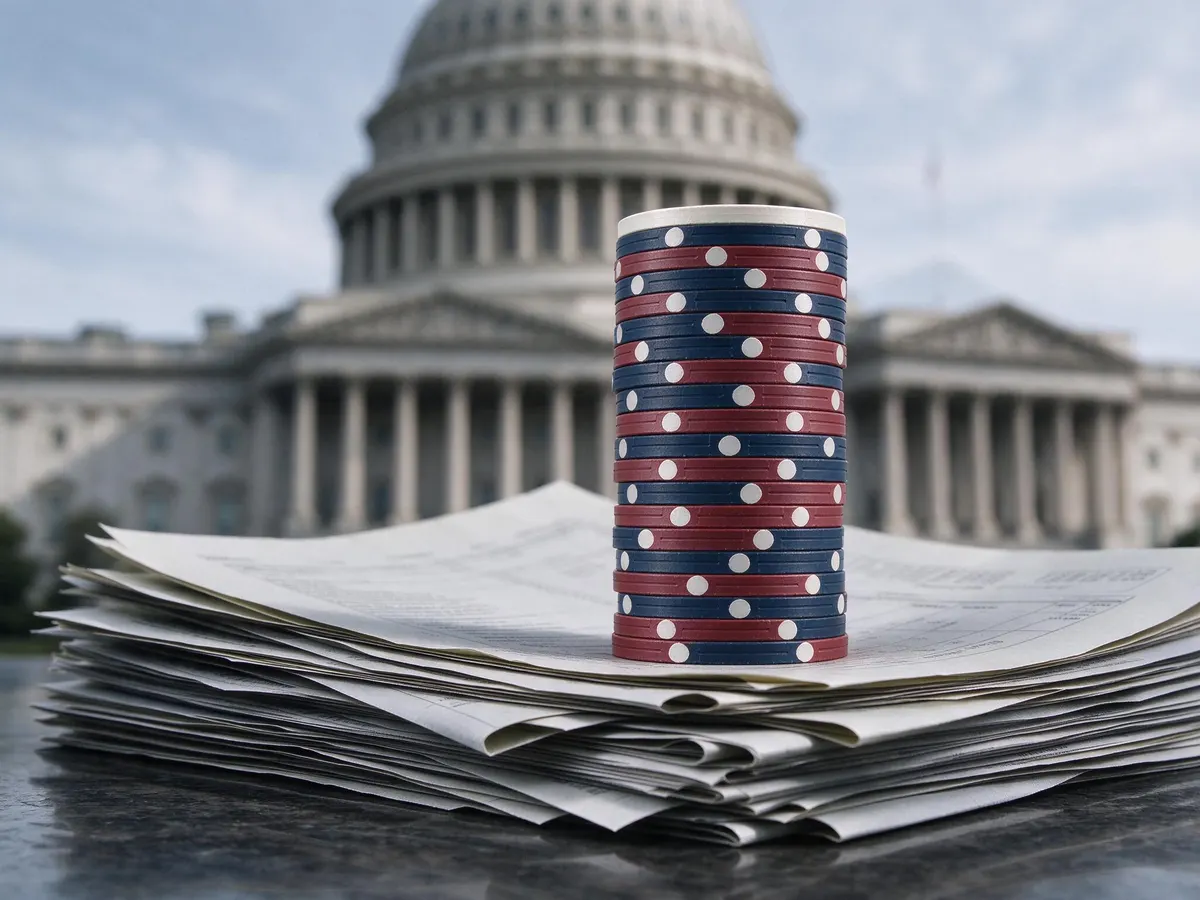
The bill had already been paid once. By the time President Donald Trump announced on Oct. 5 that his super PAC, MAGA Inc., would cover a series of 13 campaign-style advertisements, the Department of Homeland Security had reportedly already spent at least $2.5 million of federal money buying the television slots. The spots carried a “Paid for by the U.S.” line in the fine print. After objections from both parties, the funding source switched: a political committee whose single largest contributor is the richest casino owner in the world would reimburse the government instead.
That swap is a useful entry point into casino political funding, because it shows the whole chain in one frame. Gambling wealth goes into a super PAC. The super PAC spends on political advertising. And when the spending becomes controversial, private money absorbs a public cost. Below is how that chain normally works, who the players are, what the industry wants in return, and how you can trace any of it yourself using public filings.
The reimbursement case, step by step
The facts as reported are straightforward. DHS funds were used to buy commercial time for 13 advertisements. PBS NewsHour, CNBC and The Hill reported that DHS had dedicated $20 million to the ad campaign. Trump defended the original arrangement publicly, then said on Truth Social that he would pay for the ads “with money I raised for MAGA, Inc.” The push came a month before midterm elections.
MAGA Inc. can absorb that kind of cost because a handful of very large donors fund it. According to Federal Election Commission filings, Dr. Miriam Adelson, widow of Las Vegas Sands founder Sheldon Adelson, is the committee’s largest overall contributor, with a $25 million check recorded in the filings. She appears alongside Diane Hendricks and Greg and Anna Brockman among the top donors for the reporting period, during which MAGA Inc. raised close to $424.4 million.
The Adelson family’s involvement in federal politics is not new. Reporting puts their support for Trump’s presidential campaigns at more than a quarter of a billion dollars since 2016. The family also gave $5 million to the 2017 inauguration committee, and the Adelson Family Foundation is listed among donors to the White House ballroom renovation.
What makes the case instructive is the timing. Adelson’s net worth stands at $30.4 billion according to Forbes, and her family holds more than a 50% stake in Las Vegas Sands, yet the company’s shares have fallen sharply, from around $44 when the second term began in January 2025 to $36.61 at the close on Oct. 5, pressured in part by Macau and Singapore exposure. Political giving at this level is not tightly coupled to quarterly performance. It runs on a longer clock than the share price.
How casino money enters political campaigns
Casino political funding moves through several separate pipes, each with its own rules, ceilings and disclosure regime. Confusing them is the most common error in coverage of this topic.
Political action committees
Traditional PACs collect limited contributions from individuals, usually employees and executives, and pass them to candidates in capped amounts. Super PACs are the bigger instrument. Since the Supreme Court’s 2010 Citizens United decision and the related SpeechNow ruling, these committees can accept unlimited sums from individuals, corporations and unions, provided they spend independently rather than coordinating with a campaign. That is the vehicle a casino billionaire PAC donation flows through, and it is why a single $25 million check is legal at the federal level when a $25 million donation to a candidate would not be.
Direct campaign contributions
Corporations cannot give directly to federal candidates at all, a prohibition that dates back to the Tillman Act. Individuals can, but only up to a per-candidate, per-election limit of a few thousand dollars, indexed for inflation and published by the Federal Election Commission. Executives and their families therefore give direct contributions for access and signalling, and route the serious money elsewhere. State rules vary widely, and in several states corporate contributions to candidates are allowed outright.
Lobbying expenditure
Lobbying is spending, not giving, and it is often the larger line item. Operators, suppliers, trade groups and tribal gaming authorities retain in-house and contract lobbyists to work on tax provisions, licensing frameworks, sports betting bills and federal matters such as anti-money-laundering rules and the deductibility of gambling losses. Federal lobbying expenditure is reported quarterly under the Lobbying Disclosure Act, which makes it one of the easiest categories to audit.
Industry associations add a fourth channel. The American Gaming Association represents commercial operators in Washington; the National Indian Gaming Association represents tribal gaming interests. Associations pool member money, which blurs attribution while amplifying the message.
| Channel | Who can fund it | Ceiling | Where it’s disclosed |
|---|---|---|---|
| Candidate committee | Individuals, other PACs | Capped per election, indexed | FEC filings |
| Corporate or trade PAC | Employees, members | Capped contributions in and out | FEC filings |
| Super PAC | Individuals, companies, unions | Unlimited, independent spending only | FEC filings |
| 501(c)(4) advocacy group | Individuals, companies | Unlimited, politics cannot be primary purpose | Limited; donors often undisclosed |
| Lobbying | Companies, associations, tribes | No cap on spending | Quarterly LDA reports |
| State and ballot measure committees | Varies by state; often unlimited | Varies | State disclosure agencies |
Why gambling companies fund politics
Because the product only exists where a government says it can. Few industries are as directly dependent on legislative and regulatory decisions, which makes political spending a straightforward cost of doing business rather than an ideological indulgence.
Four motives recur:
- Tax policy. Gaming tax rates on gross gaming revenue vary enormously by jurisdiction, and a few percentage points decide whether a market is worth entering. Deduction rules for promotional credits matter just as much to online operators.
- Licensing and expansion. New casino licences, additional venues, and legalisation of online casino or sports betting are political decisions made by legislatures, regulators and sometimes voters.
- Rule-writing detail. Advertising restrictions, affordability checks, deposit limits, payment rules and responsible gambling mandates are set in regulation. Shaping the draft is cheaper than complying with a bad version of it.
- Competitive positioning. Incumbents frequently fund rules that favour their own model, whether that means limiting the number of licences, excluding offshore operators, or defining which entities may offer a product.
Not all of it is transactional in a narrow sense. The Adelson family’s giving has long tracked foreign policy and personal priorities as much as gaming policy, and Sheldon Adelson spent years and real money lobbying against online gambling, including online poker, which would have expanded the market his own company’s rivals wanted. Industry influence does not always point in the direction of industry growth.
Who the big casino donors actually are
The concentration is extreme. A small number of individuals and companies account for most identifiable casino political funding.
- The Adelson family. Through Sheldon Adelson until his death and Miriam Adelson since, the family has been the single largest source of casino wealth in federal politics, now visible chiefly through super PAC contributions.
- Operator corporate PACs. Las Vegas Sands, MGM Resorts, Caesars and regional operators maintain employee-funded PACs that give modest, bipartisan amounts to members sitting on relevant committees and in home jurisdictions.
- Online sportsbooks and their coalitions. DraftKings, FanDuel, BetMGM and others have funded state-level campaigns and operator alliances pushing sports betting legalisation. The 2022 California ballot fight over Propositions 26 and 27 was widely reported as the most expensive ballot measure contest in US history, and both measures lost.
- Tribal gaming interests. Tribes are sovereign governments, not corporations, which gives them a distinct legal footing for political giving. They are among the heaviest spenders in state politics, often in defence of exclusivity against commercial and online expansion.
- Individual executives. Casino principals have at times held senior party fundraising roles, including Steve Wynn’s tenure as Republican National Committee finance chairman before his 2018 resignation.
What the money changes in gambling regulation
Be careful here, because the honest answer is messier than either critics or the industry suggest. Documented contributions prove access and alignment; they rarely prove causation in a specific vote. What the record does show is a pattern: jurisdictions where operators and tribes spend heavily tend to produce legislation that reflects the spender’s preferred market structure, and the fastest-moving reforms are the ones with a well funded constituency behind them.
Sports betting is the clearest example. After the 2018 repeal of the federal ban, legalisation spread state by state at a pace that tracked operator lobbying and ballot campaigns closely. Online casino gaming, which lacks the same unified industry push and faces opposition from parts of the land-based sector and from tribes, has moved through far fewer states. Tax rates, advertising rules and the number of permitted skins per licence all bear the fingerprints of whichever side negotiated hardest.
For players, the practical consequence is that consumer protections are negotiated, not given. Deposit limit requirements, advertising standards, self-exclusion registers and dispute processes all sit in the same bills as the tax rate, and they are traded against each other. Anyone gambling in a newly regulated market should check which protections their jurisdiction actually mandated, and use the deposit, loss and session limits that are available regardless.
How to trace casino political funding yourself
All of the above is auditable. A working method, in order:
- Start with the committee, not the donor. Search the committee name in the FEC’s filings database and open its most recent receipts schedule. Donor names, employers, amounts and dates are all there.
- Identify the money’s origin. Super PAC donations often come from an individual, a trust or an LLC. Check the listed employer and address, and look for related entities giving on the same date.
- Cross-check lobbying. Pull the company’s quarterly Lobbying Disclosure Act filings and read the issue descriptions and named bills. This tells you what the money was asking for, which contributions never do.
- Drop to state level. Most gambling policy is state policy. Each state’s disclosure agency publishes candidate, party and ballot committee filings, and ballot committees are where the largest single gaming expenditures usually appear.
- Check trade associations and 501(c)(4)s. Association activity shows the industry’s collective position. Social welfare groups will not name donors, so treat gaps in that layer as gaps, not as zeroes.
- Line it up against the policy calendar. Compare contribution and lobbying dates with committee hearings, licence decisions and bill votes. Timing is the most informative data point you will get from public records.
Aggregators such as OpenSecrets are useful for a first pass, but go back to the primary filing before quoting a figure. The headline numbers in this story, $2.5 million already spent, $25 million from a single donor, $424.4 million raised by one committee, all come from filings and reporting that anyone can check. That is the part of the system that works as designed.