
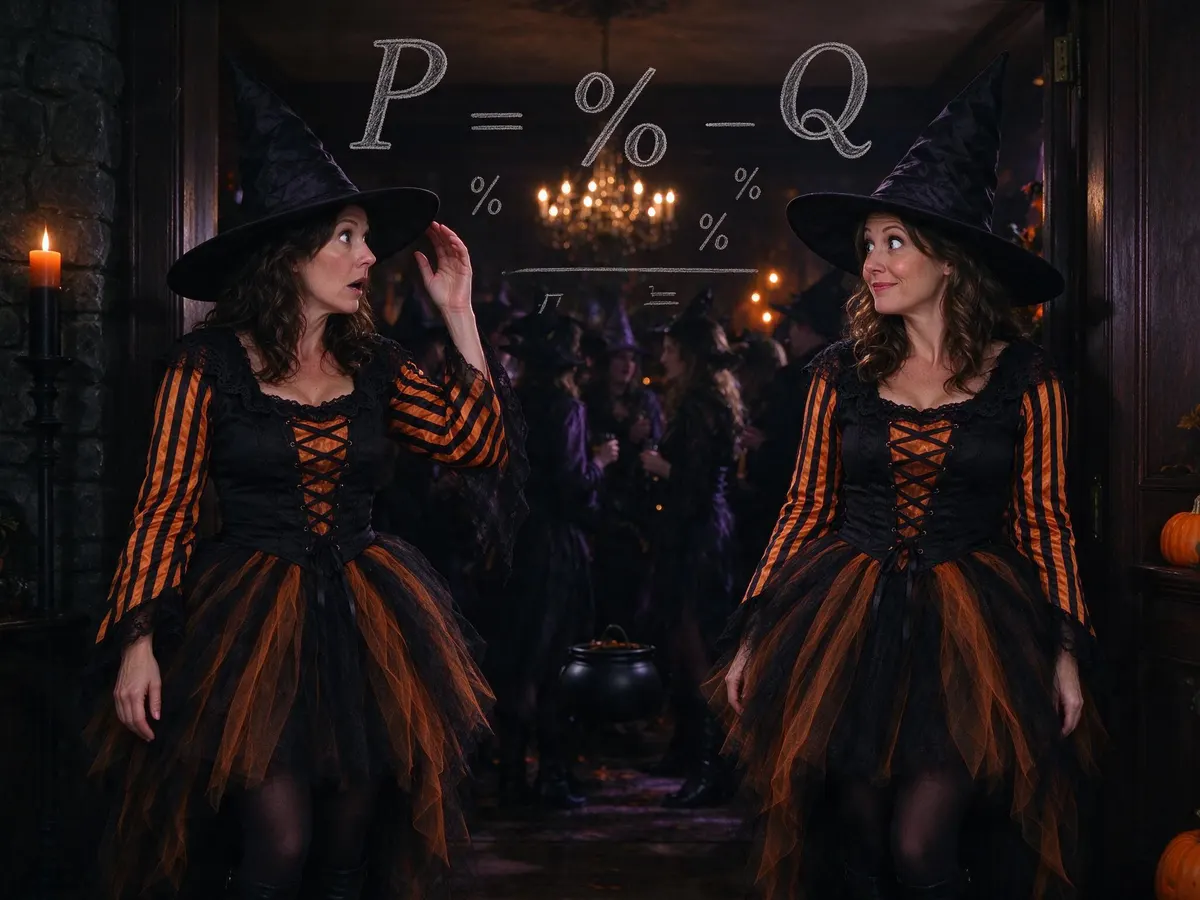
What are the odds you walk into a party dressed as someone else’s costume?
Higher than you’d like. One survey of 2,500 adults across the US and Canada found that costume wearers had roughly a 1 in 2 chance of running into their costume doppelganger, and if you’d picked a witch outfit in the US, that figure climbed to about 81%. That single statistic is a surprisingly good doorway into understanding odds and probability, because it contains almost every idea that matters: favourable outcomes, sample size, independence, and the gap between what feels likely and what actually is.
Probability, stripped of jargon, is just a number between 0 and 1 that describes how often something happens if you could run the situation many times over. Zero means never. One means always. Everything interesting lives in between, including your witch hat and every spin, hand and roll in a casino.
How odds are calculated: the one formula you need
The basic probability formula
For a single event with equally likely outcomes, probability is:
Probability = favourable outcomes ÷ total possible outcomes
Say 8 out of every 100 costumed guests this year turn up as a witch. The chance that one random guest is a witch is 8 ÷ 100 = 0.08, or 8%. Nothing mysterious there. The mystery starts when you stop looking at one guest and start looking at a room.
To find the chance of at least one match, it’s easier to calculate the opposite and subtract. The chance a given guest is not a witch is 92%. For ten costumed guests, the chance none of them is a witch is 0.92 multiplied by itself ten times, which works out to about 43%. So the chance at least one other witch shows up is roughly 57%.
Now scale the party to 40 costumed guests. 0.92 to the power of 40 is about 3.6%, meaning there’s a 96% chance you meet a twin. Same costume, same popularity, completely different conclusion. The costume didn’t change. The number of chances did.
Why sample size changes everything
Sample size works in two directions, and both matter to anyone reading odds.
First, more trials means rarer things become likely. That’s the party example above, and it’s the same reason a 1-in-37 roulette number eventually lands if you watch long enough, and the same reason a slot’s advertised return is described as a long-run average over millions of rounds rather than a promise for your next 50 spins.
Second, more data means better estimates. A survey of 2,500 people gives a reasonably stable national picture, but when the same sample is sliced into individual states and provinces, each slice rests on far fewer responses. That’s worth remembering when you see Delaware at 91% and Texas at 52%: regional differences in costume culture are plausible, but small subsamples wobble. Treat headline percentages as estimates of self-reported plans, not laws of physics.
The gaming equivalent is a player who plays 200 hands of blackjack, finishes ahead, and concludes the game is beatable. Two hundred hands is a rounding error. The mathematical edge only shows up clearly across tens of thousands of rounds, which is exactly the timescale casinos operate on and players don’t.
Probability explained simply: three ways to say the same thing
Decimal, fractional and percentage odds compared
Here’s where beginners get tangled. “1 in 2”, “evens”, “2.00” and “50%” all describe the identical chance. The format changes, the maths doesn’t. Below, a true 25% chance written four ways.
| Format | How 25% looks | How to read it | Best for |
|---|---|---|---|
| Percentage | 25% | Happens about once every four attempts | Understanding at a glance |
| Decimal odds | 4.00 | Total return per unit staked, stake included | Fast comparison and calculation |
| Fractional odds | 3/1 | Profit of 3 per 1 staked | Traditional sportsbooks, horse racing |
| American odds | +300 | Profit on a 100 stake | US sportsbooks |
The conversion you actually need is implied probability: divide 1 by the decimal odds. So 4.00 gives 1 ÷ 4 = 0.25, or 25%. Odds of 2.00 give 50%. Odds of 1.50 give about 67%.
My verdict after years of reading these: learn decimal odds as your working language and convert everything to a percentage before you decide anything. Decimals compare instantly across markets, while percentages are the only format where your gut can sanity-check the number. Fractional odds are fine once you’re fluent, but 11/8 versus 7/5 is a needless maths quiz in the moment.
One honest footnote. The implied probability from a bookmaker’s price is always a little higher than the true chance, because the margin (or overround) is baked in. Add up the implied probabilities across a market and you’ll get more than 100%. That surplus is the operator’s edge, the same way the house edge is built into every casino game.
Independent vs dependent events
Two events are independent when the first result tells you nothing about the second. A coin doesn’t remember the last flip. A roulette wheel doesn’t owe you red after eight blacks. Slot outcomes come from a random number generator, so a machine is never “due” or “cold”, no matter what the person next to you says.
Dependent events are different: the first outcome changes the odds of the second. Deal an ace from a 52-card deck and only three aces remain in 51 cards, so the chance of a second ace drops from 4/52 to 3/51. That shrinking pool is why blackjack has strategy at all, while a crash game multiplier or a slot spin genuinely has none.
Costumes sit in a messy middle, which makes them a good teaching example. If guests chose outfits in total isolation, every arrival would be independent. They don’t. People watch the same shows, shop the same stores and see the same regional trends, so choices cluster. And the survey found that about 40% of people would consider switching costumes if they learned theirs was going to be hugely popular, which means the events actively influence each other. Real-world probability is rarely as clean as a deck of cards.
Everyday odds examples beyond Halloween night
Once you can read a probability, you see them everywhere. These are all exact, calculable chances rather than estimates.
| Everyday event | Probability | The same idea in gaming |
|---|---|---|
| A fair coin lands heads | 50% | Even-money bets, before any house edge |
| Rolling a 6 on one die | 1 in 6 (16.7%) | Single-outcome bets with longer payouts |
| Two dice totalling 7 | 6 in 36 (16.7%) | Craps, where some totals are far likelier than others |
| Two people sharing a birthday in a group of 23 | About 50% | Why “at least one” outcomes beat intuition |
| One number on European roulette | 1 in 37 (2.7%) | High volatility, rare hits, bigger payouts |
The birthday row is the costume problem in disguise. Nobody expects a coin-flip chance from 23 people, because we instinctively compare ourselves to each other person rather than counting every possible pairing. Same blind spot, same fix: count the chances, not the people.
Chance and probability basics that make you a better decision maker
Here’s where the Halloween hook earns its keep. Knowing your costume has an 81% twin rate doesn’t stop the twin appearing. It just means you’re not shocked when it happens, and you can decide in advance whether you care. Probability literacy does the same job in gaming: it replaces surprise with expectation.
The concrete version is the house edge. Return to player (RTP) is the share of all wagers a game pays back over the long run, so 96% RTP means a 4% house edge. Across a huge number of rounds, that 4% is the operator’s share, and it’s why gambling has negative expected value over time for the player. European roulette’s single-number bet pays 35 to 1 on a 1-in-37 chance, which produces a 2.70% edge on every spin, whatever happens in your session.
Volatility explains the rest. A low volatility game pays small amounts often; a high volatility game pays rarely and larger. Neither changes the RTP, which is why a lucky night and a long-run average can coexist without contradicting each other.
So use the maths for what it’s actually good for: setting expectations, choosing games whose risk profile you’re comfortable with, and understanding that no sequence of results makes the next one more likely. No formula flips the edge, and anyone selling a system that claims otherwise is selling you a story. Set deposit and time limits before you play, treat the spend as entertainment rather than income, and use the responsible gaming tools your operator provides if play stops feeling fun. If you want to go deeper on the numbers, our guide to RTP and house edge picks up where this one stops.
Next Halloween, when someone walks in wearing your exact costume, you’ll know it was never bad luck. It was just the odds doing what odds do.